 asterisk labs
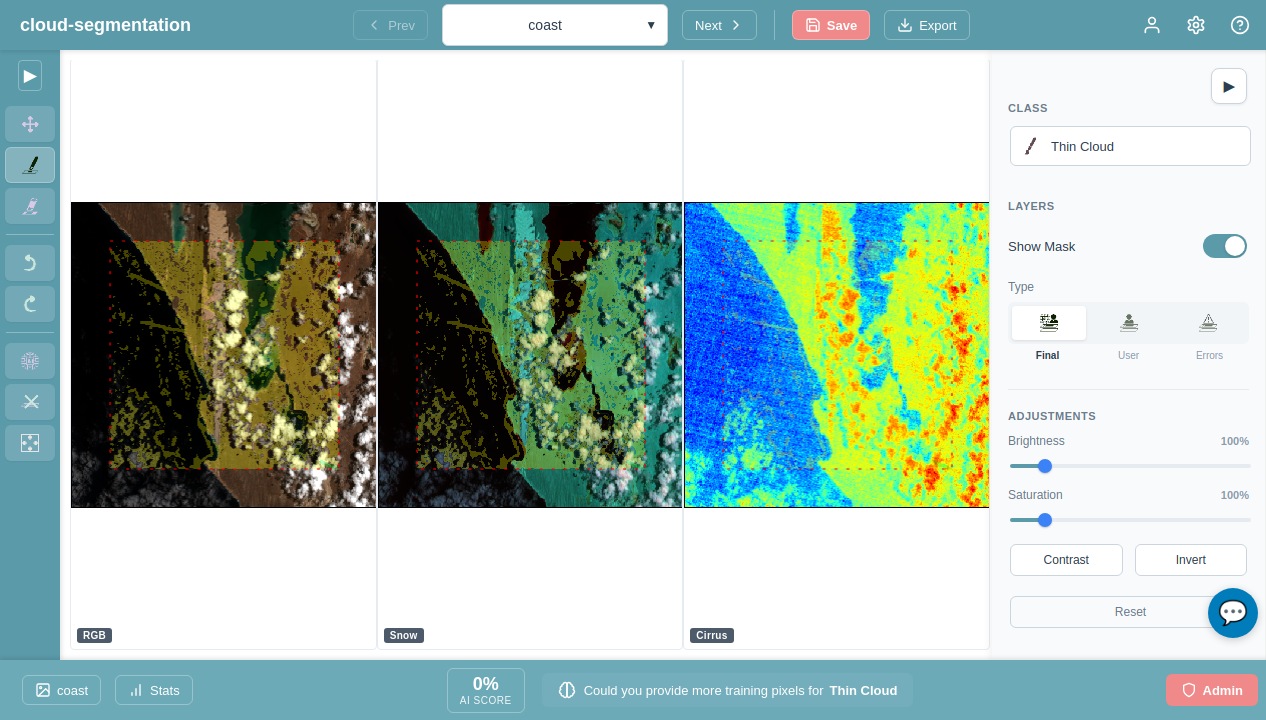
The IRIS annotation view: paint a few pixels, use the model to fill in the rest, correct the results, repeat.
IRIS is a browser-based, collaborative tool for massively accelerating the labelling of raster data with segmentation masks. It was first built at ESA Φ-lab in 2019 to speed up the annotation of cloudy Sentinel-2 scenes, and it has since become a popular tool that has been used for a range of other tasks. The user paints a few pixels of each class, an ML model is trained on those pixels and predicts the rest of the image, and the user corrects the prediction and trains again. This iterative loop helps a user annotate an image accurately in a much shorter time than it would take to manually paint it.
Previous versions
The original IRIS. Many of the core features remain the same, despite the updated look.
In 2025, the Scientific Software Engineering Center at Georgia Tech, supported by Schmidt Sciences through its Virtual Institute for Scientific Software (VISS), took IRIS from a research prototype towards a maintainable piece of software. The interface was rebuilt in React and TypeScript, with user accounts, an administration view and a built-in project configuration editor, and the Python backend was refactored, packaged and given a test suite and continuous integration. That overhaul has laid the groundwork for the changes we are now making to IRIS, which you can read about below.
New developments
IRIS retrains its model from scratch for every image, which keeps labelling errors from spreading between images but also means that nothing learnt on one image helps with the next. That design made sense when the point of annotation was to build a labelled dataset for training a convolutional model. Now that pre-computed embeddings are available for the whole planet, a linear model on AlphaEarth or TESSERA embeddings can separate many classes from a handful of examples, and the goal of an annotation project becomes a mapping from classes to regions of a latent space, that can be applied anywhere. Over six months, with the support of ESA Φ-lab, we are extending IRIS along four lines to bring it up to date with modern embeddings-first workflows.
Hover over a theme to read more.
Embeddings workflows
Pixel-wise embeddings are added as an image source, with a linear classifier alongside the existing gradient boosted trees, and with annotations shared across the dataset so that a new image arrives with a prediction already drawn. Image-level embeddings from models such as THOR and TerraMind are used to choose which image to annotate next, by looking for the one least like those already labelled, and to decide which images are similar enough to share annotations at all. Language-aligned embeddings, where a class is described by a sentence and the embedding model turns it into a first guess at the mask, are the least certain part of the plan.
Agentic setup
Building a dataset is still the slowest part of starting a project. We are adding a catalogue of data sources and an assistant that turns a description of the task, the region and the data you want into an IRIS project, with views and classes chosen to suit the job. This will lower the barrier-to-entry so that anyone can use IRIS.
Time-series annotation
Many tasks need labels that change through time. IRIS will have a new mode that can step through the dates available for a place and keep a mask for each, so annual embedding products and seasonal imagery can be labelled over time rather than one scene at a time.
Visualisation and speed
Embedding products and hyperspectral data can carry hundreds of bands. We are reworking how IRIS stores, loads and displays imagery so that views over many bands are quick to make and quick to draw, with cloud-native formats that let the browser read only what it needs.
User community
IRIS has been downloaded and forked many times, but as an open source project with a permissive licence we have little idea what it has been used for or what its users would change. We are conducting a user survey and setting up a forum where development can be discussed. From that group we will pick two champion use cases, build their datasets with them whilst the new features are being written, and release both datasets at the end of the project. The results and the tool will be presented at a webinar in early 2027.
Anyone who has used IRIS and would like to be involved is welcome to get in touch at hello@asterisk.coop.
User survey
Links